Arivue is the investment-case layer upstream of planning and SPM systems. Your team uses it to structure the problem, options, value drivers, costs, risks, and financials, then preserve the approved baseline for change and value tracking.
Eight linked product stages, one governed record. Each stage grounds the next.
Start with a short brief, or run a guided discovery that captures the current state, the problem, the target state, success measures, and stakeholders. Nothing here is thrown away: it grounds everything downstream.
Arivue combines your company context and business requirements with cited public-web research on relevant vendors, solution approaches, pricing signals, and competitive context before options are ranked.
Distinct, ranked options, including an explicit build, buy, or hybrid view where it applies. You see the trade-offs, not just a single recommendation.
A work breakdown that decomposes effort by task and role, and a cost built up from sourced line items, from firm quotes down to estimates, each carrying its own confidence, rather than a single guessed number.
Value drivers are quantified with the right formula for each benefit type, each one carrying its own adoption and attribution assumptions rather than one blanket multiplier.
The financial engine computes NPV, IRR, payback, and Cost of Delay, and reconciles them to the recommended option, line by line.
The case flags its own weak points before a committee does: an estimate standing in for a quote, an unmeasured adoption assumption, a driver carrying more than its share of the benefit.
A stated ask with a recommendation and confidence level, preserved in an auditable workflow for review and sign-off.
NPV, IRR, payback, and Cost of Delay come from the financial engine, grounded in the assumptions on the page. Ask the same case twice and you get the same answer.
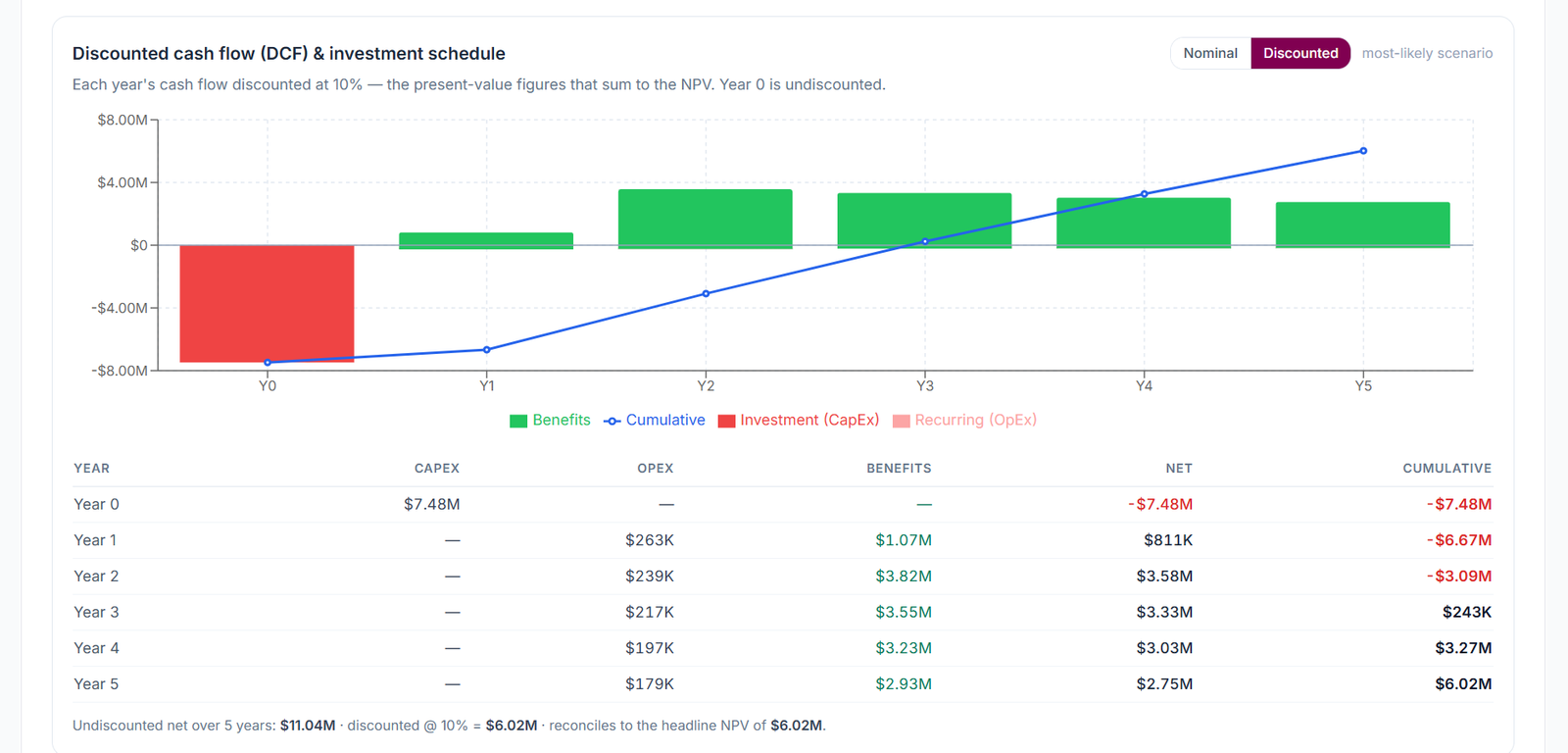
From a real case, built by the platform. See the full case →
The Trust Engine reads the finished case and looks for the gaps that sink approvals: numbers that do not add up, a recommendation that is not the option being financed, or a hard requirement in tension with the plan.

From the same real case. See it in context →
A budget-screening decision does not need a full investment case. A committee decision does. It is the same business case either way, deepened in place.
A defensible first case from a brief in minutes, ready to screen or share.
Add discovery, a work breakdown, an assumptions and risks defense pack, and quantified sensitivity.
Depth builds on what is already there. You never restate what you have already told it.
Export decision materials from the same governed case, so the executive view and detailed analysis stay aligned.
Arivue creates and defends the investment case that planning, portfolio, and delivery systems govern. It complements those systems rather than replacing them.
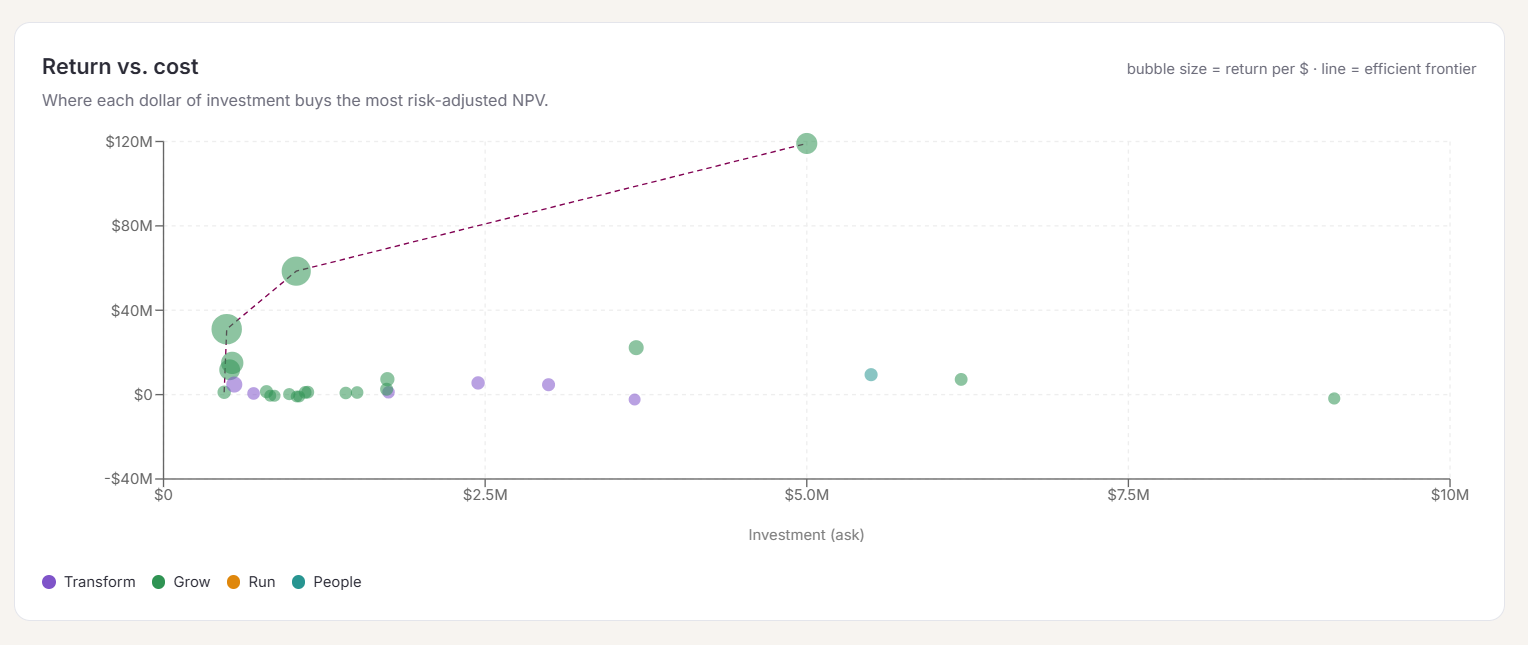
Compare ROI and other KPIs across every investment for portfolio-level decisions.
A focused demonstration shows how an enterprise team creates, challenges, governs, and tracks a case in Arivue.